My Work Driving Innovation in Precision Oncology Through Structure-Based Drug Design
6+ FDA IND filings across oncology, immunology, and virology, anchored by structure-based drug design against some of the toughest targets in precision medicine. I delivered the structural biology behind INCB161734, a potent and orally bioavailable KRAS-G12D inhibitor with 80-fold mutant selectivity (AACR 2024 poster) now in Phase 1 trials, alongside co-crystal structures and SBDD support for clinical-stage programs targeting CDK2, FGFR2/3, the first-in-class mutant CALR antibody INCA033989, JAK1, and JAK2-V617F. Together, these programs integrate AI-driven design with high-throughput X-ray crystallography and cryo-EM to compress lead-optimization timelines and accelerate precision medicines to patients.
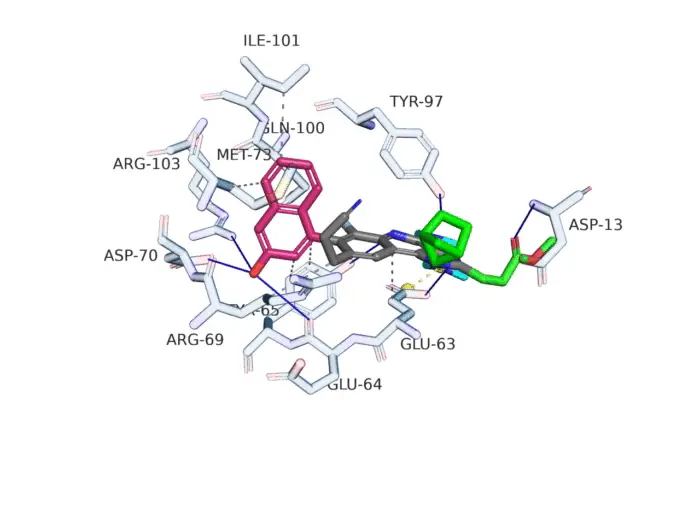
Movie of KRAS-G12D bound to INCB161734
- KRAS-G12D Precision Targeting: INCB161734 shows 34% response in relapsed pancreatic cancer, leveraging 80× selectivity for mutant KRAS and advancing in combination trials.
- CDK2-Driven Ovarian Cancer: INCB123667 delivers 33% responses in platinum-resistant cases with cyclin E1 amplification, now entering the MAESTRA-2 pivotal study.
- FGFR2/3 Resistance Control: Structure-guided inhibitors overcome FGFR gatekeeper mutations (V564F, V555M), addressing resistance across ~36% of FGFR2-altered cancers.
- Mutant CALR Immunotherapy: INCA033989 achieves 86% response in essential thrombocythemia by eradicating mutant CALR⁺ stem cells, indicating curative potential in ongoing trials.
- JAK2-V617F Molecular Remission: INCB160058 targets the pseudokinase domain with 2,500× mutant selectivity, eliminating JAK2-V617F clones while preserving normal blood cell formation.
- KRAS-G12D Inhibitor (INCB161734): Optimized scaffold design delivers high mutant selectivity through switch II pocket engagement.
- CDK2 Inhibitor (INCB123667): Pyrazolyl‑aminopyrimidine series establish precision control of cyclin E–CDK2 signaling.
- FGFR2/3 Inhibitor (INCB054828): Co‑crystal models reveal flexible hinge binding overcoming gatekeeper steric clashes.
- Mutant CALR Antibody (INCA033989): Engineered antibody backbone achieves allele‑specific recognition of mutant calreticulin epitopes.
- JAK2‑V617F Inhibitor (INCB160058): Structure‑based design leverages pseudokinase domain insights from povorcitinib lineage.
- Discovery of Povorcitinib (INCB054707): An Isoform Selective Janus Kinase 1 (JAK1) Inhibitor.
Advancing targeted therapies from molecular insights to clinical breakthroughs across multiple cancer-driving mutations
Precision oncology has undergone a remarkable transformation over the past five years, driven by the integration of structure-based drug design with advanced molecular profiling and biomarker-driven patient selection strategies. My work at the intersection of structural biology and drug discovery has contributed to developing highly selective inhibitors targeting oncogenic drivers that were once considered undruggable, translating fundamental protein science into clinical candidates that address critical unmet needs in cancer treatment. This journey spans KRAS-G12D mutations in pancreatic and colorectal cancers, CDK2 dependencies in platinum-resistant ovarian cancer, FGFR2/3 alterations across multiple solid tumors, and mutant calreticulin in myeloproliferative neoplasms—each representing distinct challenges that required tailored structure-guided approaches to achieve therapeutic selectivity while sparing normal cellular function.
KRAS-G12D Inhibitor: Transforming Pancreatic Cancer Treatment
The KRAS-G12D mutation represents one of the most prevalent oncogenic drivers in pancreatic ductal adenocarcinoma, occurring in approximately 45% of cases, as well as 15% of colorectal cancers and a subset of lung cancers. Structure-based design efforts led to the development of INCB161734, a potent oral inhibitor demonstrating over 80-fold selectivity for the G12D mutant versus wild-type KRAS through precise exploitation of conformational differences between the mutant and normal protein. In ongoing Phase 1 clinical trials, INCB161734 achieved a remarkable 34% objective response rate at the 1,200 mg daily dose in patients with relapsed pancreatic cancer, with 86% disease control rate, representing unprecedented activity in this difficult-to-treat population. Critically, the compound demonstrated continuous near-maximal target engagement in preclinical models, and early clinical data showed 72% of patients treated at 1,200 mg achieved greater than 90% reduction in circulating tumor DNA KRAS-G12D variant allele frequency, providing a molecular surrogate of therapeutic response. The favorable safety profile with manageable predominantly mild gastrointestinal and hematologic adverse events, combined with no dose-limiting toxicities reported, supports advancing combination strategies with standard chemotherapy regimens and immunotherapy agents, with pivotal trials anticipated to launch in first-line pancreatic cancer settings in 2026.
CDK2 Inhibitor: Precision Targeting in Ovarian Cancer
Cyclin-dependent kinase 2 emerges as a critical therapeutic vulnerability in ovarian cancers exhibiting cyclin E1 overexpression, a biomarker present in a substantial subset of platinum-resistant cases where treatment options remain severely limited. The development of 4-pyrazolyl-2-aminopyrimidines as potent and selective CDK2 inhibitors represents a structure-guided approach exploiting the synthetic lethal relationship between CDK2 inhibition and cyclin E1 overexpression in cancer cells that become dependent on CDK2 for survival. INCB123667, the clinical candidate from this chemical series, demonstrated compelling proof-of-concept efficacy in heavily pretreated patients with platinum-resistant or refractory ovarian cancer, achieving a 33.3% objective response rate with 100 mg daily dosing in a Phase 1 study, with all but one responder demonstrating cyclin E1 overexpression, validating the precision biomarker approach. The median progression-free survival of 5.3 months and duration of response of 3.6 months, coupled with over 70% of patients experiencing tumor shrinkage, represents meaningful clinical benefit in a population that typically has exhausted multiple prior therapies including bevacizumab and PARP inhibitors. Importantly, the manageable safety profile with predominantly grade 2 or lower hematologic and gastrointestinal treatment-emergent adverse events, and only 2.2% discontinuation due to toxicity, supports the advancement into the MAESTRA-2 pivotal trialtesting INCB123667 versus chemotherapy in biomarker-selected platinum-resistant ovarian cancer patients.
FGFR2/3 Inhibitor: Overcoming Gatekeeper Mutations
Fibroblast growth factor receptor alterations, including activating mutations, amplifications, and gene fusions in FGFR2 and FGFR3, drive oncogenesis across cholangiocarcinoma, bladder cancer, and other solid tumors, but therapeutic efficacy of first-generation FGFR inhibitors remains limited by acquired resistance through gatekeeper mutations such as V564F in FGFR2 and V555M in FGFR3 that create steric hindrance preventing drug binding. Structure-based design approaches enabled the discovery of potent and selective inhibitors capable of overcoming both wild-type and gatekeeper mutant FGFR2/3, addressing a critical clinical need as approximately 36% of all FGFR2 alterations consist of molecular brake or gatekeeper mutations, enriched to 51% and 57% in cholangiocarcinoma and breast cancer respectively. These next-generation compounds maintain potent inhibitory activity against resistance mutations by exploiting alternative binding modes that avoid direct steric clashes with the enlarged gatekeeper residue, validated through crystallographic analysis and biochemical profiling. The development strategy incorporated targeted protein degradation approaches, with FGFR2-selective degraders achieving DC50 values of 0.645 nM and demonstrating superiority over parental inhibitors against the FGFR2-V564F gatekeeper mutant with IC50 of 0.121 nM, providing a comprehensive toolkit to combat resistance mechanisms. This structure-informed precision medicine approach addresses the polyclonal resistance observed clinically, where patients develop multiple concurrent FGFR2 mutations following first-generation inhibitor therapy, enabling broader and more durable disease control.
Mutant Calreticulin Antibody: Targeting Myeloproliferative Neoplasms
Calreticulin mutations represent the second most common oncogenic driver in myeloproliferative neoplasms, present in approximately 25% of essential thrombocythemia and 35% of myelofibrosis patients who lack JAK2-V617F mutations, creating constitutive activation of the thrombopoietin receptor through unique mutant protein sequences absent in normal cells. The development of INCA033989, a fully human IgG1 monoclonal antibody specifically targeting mutant calreticulin, represents a precision immunotherapy approach that selectively eliminates cancer cells expressing the mutation without affecting normal hematopoiesis. Preclinical validation demonstrated that INCA033989 binds mutant calreticulin on the cell surface, blocks the mutant CALR-MPL interaction, inhibits JAK-STAT signaling selectively in patient-derived CD34+ cells while preserving signaling in healthy donor cells, and induces dynamin-dependent endocytosis of the antibody-receptor complex. In competitive transplant mouse models, ten weeks of INCA033989 treatment prevented thrombocytosis, significantly decreased mutant calreticulin stem and progenitor cells in bone marrow, and critically targeted disease-propagating hematopoietic stem cells, as evidenced by the absence of MPN development in secondary transplantation, demonstrating disease-modifying potential beyond symptom management. Clinical translation is advancing through a Phase 1 trial in patients with CALR-mutant essential thrombocythemia, where early data presented in 2024 showed an 86% response rate, representing the first therapeutic antibody designed to selectively target and eliminate specific cancer-driving mutations in myeloproliferative disorders.
JAK2-V617F Selective Inhibition: Achieving Molecular Remission
The JAK2-V617F mutation drives nearly all cases of polycythemia vera and over half of essential thrombocythemia and myelofibrosis, yet current JAK inhibitors targeting the kinase domain provide symptomatic benefit without addressing mutant allelic burden or achieving molecular remission. INCB160058 represents a first-in-class approach using structure-guided molecular design to bind with picomolar affinity to the pseudokinase JH2 domain of JAK2-V617F, achieving over 2,500-fold selectivity relative to the wild-type JAK2 kinase domain targeted by approved therapies. This pseudokinase-binding mechanism blocks ligand-independent thrombopoietin receptor dimerization induced by the V617F mutation, resulting in loss of downstream kinase activity while preserving cytokine-dependent wild-type JAK2 signaling essential for normal hematopoiesis. X-ray crystallography analysis revealed the inhibition mechanism involves conformational disruption of the αC helix motif upon INCB160058 binding to the JH2 domain, providing atomic-level understanding of selectivity determinants. Preclinical validation in patient-derived models demonstrated that continuous exposure to INCB160058 at sub-IC50 concentrations progressively eliminated JAK2-V617F-positive cells in co-cultures without affecting wild-type cells, and in patient-derived xenograft models selectively reduced human JAK2-V617F cell engraftment and hematopoietic stem/progenitor cells while sparing healthy donor cell populations. The compound normalized pathogenic cytokines including interleukin-6 and interleukin-8, and importantly demonstrated tolerability with significant antitumor activity in vivo, supporting clinical development initiated in 2024 in patients with JAK2-V617F-positive myeloproliferative neoplasms resistant or refractory to current JAK inhibitors, with the therapeutic goal of achieving molecular remission through selective eradication of mutant clones.